
Seven Deadly Sins, Part 2: Religion
From the first time our distant ancestors looked at the sky and thought, "Sun good, flood suck," humans have turned to the Gods to make sense of the world and to try to influence it.
Religions, of one kind or another, have been around as long as we have. They wouldn’t be a problem if religious people just did their own thing and left everyone else do theirs. Most do, but then there are the ones who think their way is the only way and everyone else needs to get the fuck into line.
Karl Marx said religion is the opiate of the masses because he saw it as a tool used by the ruling class to keep the working class passive and distracted from the realities of their oppression, offering them comfort in the face of suffering without addressing the root causes.
Religion has brought people together, torn them apart, inspired kindness, and fueled violence. It’s f*cked the world, but given many hope while doing it. It’s lifted people up, torn them down, saved lives, ruined them. It’s given meaning, and given arseholes a moral permission slip to persecute whoever they already hated.
There are roughly 4,000 religions kicking around today, and probably hundreds, maybe thousands more that lived, died, and left nothing but a few strange myths and a pottery shard or two. Dr Gary Wenk, a psychologist and neuroscientist at Ohio State University, reckons humans have worshipped at least 18,000 gods, goddesses, animals, spirits, and miscellaneous cosmic mascots over the course of our existence.
In a 2021 piece for Psychology Today, Wenk made a point that hits harder than people think: if spirituality didn’t offer something useful for surviving or reproducing, evolution should’ve binned it ages ago. Instead, people built pyramids for dead kings, sacrificed their own children to please the sky God, and, in the modern era, blew themselves up for the promise of paradise.
In other words: belief sticks because it does something for us, even when it costs us everything.
(Dr Wenk is a leading authority on the consequences of chronic brain inflammation. Just sayin).
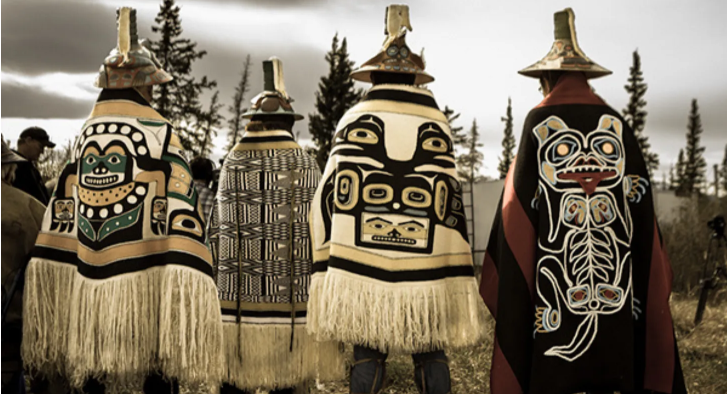
Tlingit (pronounced “klinget”) people of Alaska
But I hear you say, religion and spirituality aren’t the same thing. Fair. Religion is the structure, the rules, rituals, calendars, buildings. Spirituality is more personal: meaning, connection, that sense of “something bigger” that doesn’t fit neatly into a hymn book. Plenty of people mix the two. For them, religion and spirituality are just different paths to the same place - the “holy.”
But what makes someone or something holy? Is it something that comes from inside, or something we impose on people and things? Does belief make something holy? Is holy even the right word?
For many First Nations peoples across the world, the whole universe carries its own power, shared, transferred, alive. Mother Earth isn’t a metaphor; she’s a living, breathing, nurturing being. Everything is connected, and anything that happens in one place is echoed somewhere else. Holiness isn’t a building or a book, it’s the web of relationships that keep life going. Think of it like the Force in Star Wars, an energy that binds everything together.
Many religions promote hierarchical relationship between God, humans, and nature, with God at the top, humans next, and nature at our disposal. These religions typically view God as separate from His/Her/Their/It’s creation, rather than a part of it.
So, which, if any, feels truer to you? And when someone is called holy, does that necessarily mean they’re a good person?
I’m not so sure it does.
Take Mother Teresa, or Saint mother Teresa now. Millions of people around the word think she’s, well, a saint, and she is now. In 2016, Pope Francis declared “Blessed Teresa of Calcutta to be a saint” for “dedicating her life to caring for the destitute in India” Few less deserving people have got such high praise.
In the Catholic rule book it says, “By their fruits you will know them” (Matthew 7:16).
Well, if you judge Mother Teresa by her fruits, her actions, you’ll know that she was a truly nasty individual.
A 2013 study by researchers at the Universities of Ottawa and Montreal, published in the journal Religieuses, tore the saintly myth to shreds. They found that the glowing image of Mother Teresa was pure bollox. Despite being rolling in donations, the 500 homes she ran were filthy. The food was terrible when it existed at all. The medical care was medieval, there were no painkillers, and patients were treated more like prisoners than people.
She didn’t alleviate suffering, she loved it.
She believed that suffering brought people closer to Christ, so she did nothing to ease their suffering. The now saint Theresa once said, “There is something beautiful in seeing the poor accept their lot, to suffer it like Christ’s Passion. The world gains much from their suffering,” Mother Theresa was a sadist!
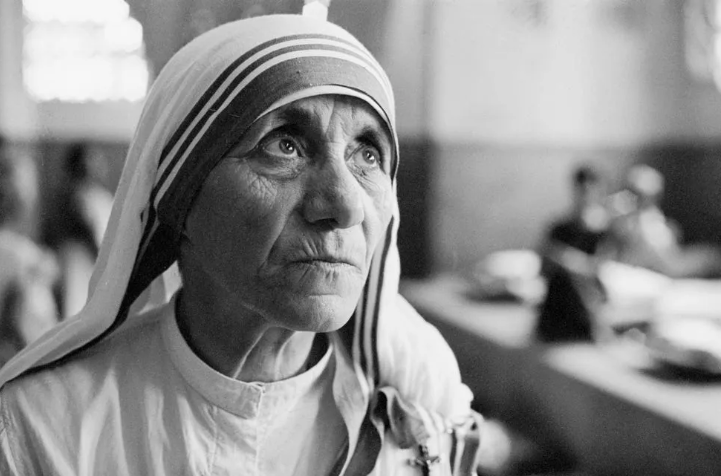
Saint (Mother) Teresa of Calcutta
Religion has also been responsible for some truly messed up stuff. The Crusades, for example, were a series a murder tours of the middle east. The crusaders did some awful things: they slaughtered Muslims, Jews, and even Christians.
At the siege of Ma’arra in 1098 CE. starving and delirious, the crusaders resorted to an “unspeakable feast”, a polite way of saying they cooked and ate the dead. All to save the Holy Land from something it didn’t need saving from.
When the first crusade was launched in 1096 CE, the Holy Land was doing just fine. Christians, Muslims and Jews all got along generally quite well, give or take the odd riot. All was going well until this rabble of smelly, unwashed, illiterate westerners swarmed in on the pretense of being there to save the Christians, but were often there for a bit of murder and looting.
At a time when even the educated in England and France believed that unicorns were real and illnesses were caused by sin, the Islamic world was the centre of learning. Arabic scholars were lightyears ahead of those in the West when it came to science, literature and art. Ibn al-Haytham (Alhazen) wrote the “Book of Optics” which revolutionised the understanding of light, laying the groundwork for modern scientific methods and influencing European scholars. An Arab scholar had even correctly measured the distance from the earth to the moon. And then these filthy psychopaths appear out of nowhere, murder everyone they can get hold of, and start eating people in the name of God.
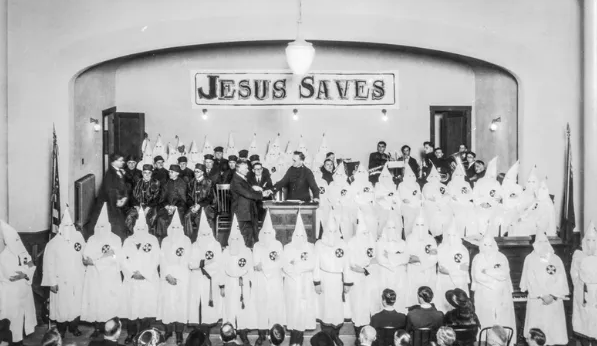
Ku Klux Klan “revival” event, Alabama, 1927
You know who else claims to be good Christians? The KKK. The largest KKK group today are the Knights Party. Their Annual Soldiers of the Cross Bible Camp and is billed as “3 Family-Friendly Days.” Activities include Bible studies and gospel music concerts. I’m not sure if there are lynchings at the festival, but you can tell they’d like to have them.
And then, of course you have Islamic extremists like the Taliban, who enforce a strict systematic gender apartheid. Women are not allowed even the smallest freedoms like university education, to run businesses, or even show their faces in public. Since last year, Afghan women aren’t even allowed to look directly at men they’re not related to by blood or marriage. What a monumental shower of assholes.
This is what you get when extremists twist religion. Most of this isn’t even Islam. It’s Pashtun tribal custom, and extreme even for that. The vast majority of Muslims agree that Islam encourages education for both men and women, and that seeking knowledge “from the cradle to the grave” is a religious duty. The Taliban didn’t read that part. Or they did and decided it didn’t fit the vibe of their arseholery.
Now, there are exceptions that make every rule. Organisations like the Red Cross and Islamic Relief are rooted in religious principles of compassion and helping others. Also, the arts, literature, and music owe a huge debt to religion, although there are contradictions there too.
Caravaggio painted the sacred using the people the church ignored: the homeless, sex workers, the poor, the drunk, the bruised. And the church hated it. They thought it was blasphemous to put the divine in the same frame as the destitute. The irony, of course, is that the Jesus Christians call the Saviour, and Muslims call a prophet of God, would’ve been perfectly comfortable drinking wine and swapping stories with every one of those “destitute” people.
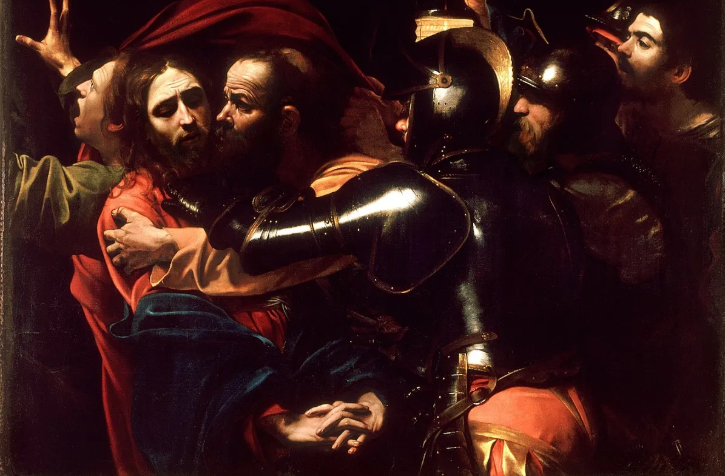
Caravaggio’s The Taking of Christ, 1602
Art aside, there’s no ignoring religion’s darker side. It’s been used to justify discrimination, oppression, and violence. Jonathon Swift, the guy who wrote Gulliver’s travels, summed it up perfectly, “We have just enough religion to make us hate, but not enough to make us love one another.”
I guess I should say something about atheists too. I don’t mean those casual non-believers that really couldn’t care less one way or the other. I mean religious atheists.
Atheism can look very much like a religion too, especially when it becomes someone’s entire personality, the way some radical vegans can make kale feel like a political statement. Plenty of atheists get just as fierce, just as absolute, and just as ready to tell you you’re an idiot if you dare suggest the universe might contain something mysterious.
Some atheists even build communities, debate morality, wrestle with meaning, and defend their worldview with the same fire-and-brimstone energy as any church group. They might not have hymns or holy days, but they’ve definitely got shared purpose, shared identity, and sometimes shared superiority complexes.
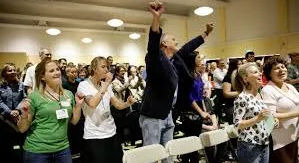
Sunday Assemby Atheist Church
And let’s be honest: a few of them can be as vicious toward believers as believers can be toward them. Hell, there are even atheist “churches” popping up in the UK and the US, where people gather every week to talk ethics, sing songs, and remind each other there’s definitely no God, which is about the most religious thing they could possibly do.
It’s the moralistic bullshit that really gets me. The anti-this, anti-that, anti-gay, anti-whoever-happens-to-be-living-a-life-they-don’t-approve-of crowd. The people who treat doctrine like a weapon rather than a guidebook. “My religion says this is wrong, so you can’t do it.”
Why not just mind your own business?
You don’t like gay marriage?
Don’t get gay married.
Hating people for who they are while believing you’re doing God’s work isn’t righteousness, it’s a socially acceptable mental illness.
In the end, religion doesn’t make a good person. Especially not if the only thing stopping you from being awful is the fear of eternal damnation. That’s not morality, it’s blackmail. As the saying goes, “You don’t need religion to have morals. If you can’t determine right from wrong, you lack empathy, not religion.”
Goodness should be measured by a person’s capacity to act kindly and morally in the context of their circumstances. To try your best. To be decent even when you fail sometimes. That’s what makes a person good, not how many prayers they can rattle off, not how many rules they obey, not how loudly they declare themselves holy.