
Pub: a love story: Part Four
Tuesday Night
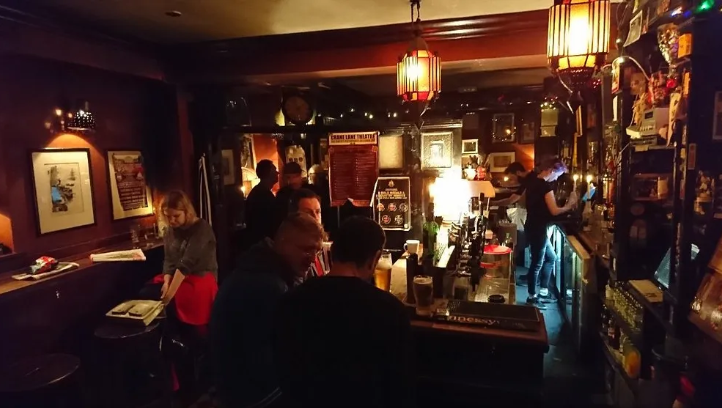
Tuesday night at the Mutton Lane Inn.
It’s a narrow pub. The yellow light comes from hanging lamps and the glow behind the bar. All the corners are in the shadows. The walls are dark, covered with frames, notices, posters, a stopped clock.
The staff are further down the bar, serving people at that end.
There’s no smoke inside. Smoking is banned in Irish pubs. The smokers are outside in the old laneway, barely visible in a cloud of smoke.
Three men sit at the bar, drinks in front of them, backs to us. Two are talking. The third looks straight ahead, not at anyone.
On the left, a woman in a red wrap is sitting on a high stool, facing slightly away from the bar. Sitting with her own thoughts. She’s looking down at something in her hand, out of sight - a phone, maybe, or a small notebook.
People come in, stop for a while, take up a bit of space, then move on. Nothing is arranged. The clutter has built up over 200-years. The room isn’t trying to be anything other than a shared room. A sitting room away from home.
“Nothing is arranged. The clutter has built up. The room isn’t trying to be anything other than a shared room.”
Over 15,000 pubs have closed in Britain since 2000. In Ireland, over a quarter of all pubs have closed in the last twenty years. Not because people stopped drinking, but because rising rents, and utility bills, corporate ownership, and a licensing system that favours scale.
When a pub closes, it’s more than a business failing. Sociologists and community groups describe it as a hollowing-out of a neighbourhood. The loss of a shared room that held people together without asking much of them. Where people of different ages, social classes, and backgrounds interact as equals. The damage isn’t abstract. It shows up slowly, across everyday life, as places to pause, meet, and linger disappear.
One way of understanding this loss is through Ray Oldenburg’s idea of the “third place”, somewhere that isn’t home and isn’t work. When those are the only two places left, social life thins out.
People say that cafés or gyms will replace the pub, but they don’t work the same way. They’re transactional, time-limited, and purpose-driven. You don’t sit in a coffee shop for hours after a shift. You don’t drift into conversations with strangers. The pub allowed that kind of unstructured time. Often, the pub is replaced with flats, offices, convenience stores. The bar goes. The walls are cleared. The clutter that recorded decades, perhaps centuries of use is lost.
What vanishes isn’t just a room, It’s memory. Memories the people who drank there. he people who drank there. Couples who met at the bar. The man who always stood in the same spot. The woman who drank one pint and left. The regulars whose names you never knew, but whose absence would be noticed. All lost.
For many people, especially in rural areas, or those living alone, the pub is also a social lifeline. It’s a reason to leave the house. You don’t need an invitation, a membership, or a reason to be there. You just turn up. Bartenders notice when a regular doesn’t turn up. Someone might ask where you’ve been. Someone will call to the house to check on the one who has been missed. When pubs close, that quiet form of care disappears. Surveys from recent years show rising isolation after local pubs shut, with people retreating further into private and digital spaces instead.
For working-class communities in particular, the pub has long been a marker of continuity. Its disappearance can feel like a signal that a way of life is dying.
And the effects ripple outward. In rural areas, the pub is often the reason people visit at all. When it closes, local B&Bs, shops, and suppliers feel it. Small breweries lose a public window. Foot traffic drops. One closure pulls others with it.
“Pubs are easy to overlook while they’re still there.”
On a Tuesday night, nothing much is happening. People stand, read, wait, finish a drink. The pub is easy to overlook while it’s still there. You may only notice how much you care for it when it’s gone. And then it will be too late.
The pub is the great, enduring love of the people. If we don’t try to keep them open, it becomes a requiem.