
Pub, a love story: Part One
The Victorian Public House
Prologue
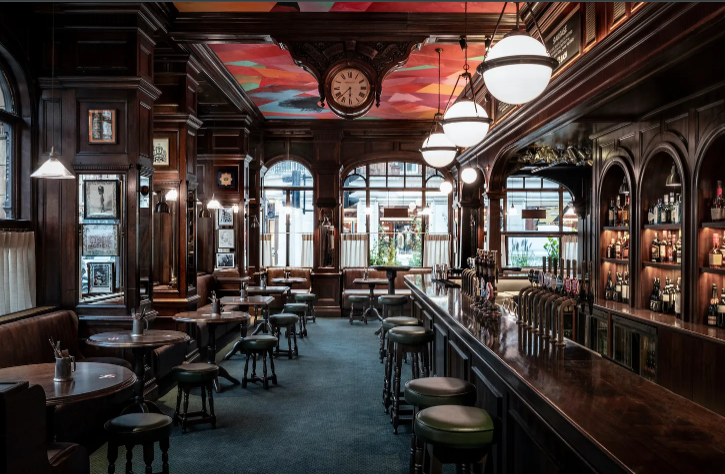
The Audley Public House, Mayfair. opened 1888
In the streets of ten thousand towns, there was a pub.
On the narrow lanes in Cork and in the shadow of factories in Sheffield,
beside shipyards in Belfast and the coal mining towns in Wales.
In industrial districts they were the breakwater against the constant grind,
where miners, dockers, and factory hands drank, and sang, and laughed, and fought.
In the countryside, they were lifelines.
Post office, grocer, and sanctuary in a single room.
Some were called Spirit Grocers: in J. & K. Walsh in Waterford City, or the House of McDonnell in County Antrim, tea and canned goods sat on one side of the counter and whiskey on the other.
They were the birthplaces of political parties and unions,
of strikes, football clubs, and uprisings.
They were where love affairs began,
and where revolutions were started.
The Manx Arms in Douglas hosted secret nationalist meetings.
Chartists organised at the Eagle Tavern in Salford.
The Crown Tavern in Belfast sheltered political organisers.
The Red Lion in Soho welcomed socialists, Fabians, and the occasional lecture from Karl Marx and Friedrich Engels.
If you needed bread or bail money or a blessing, it could be found in a pub.
Some were used as gaols and courthouses.
Under the Coroners Act of 1846, the dead were brought to them as well,
laid out in the cellar or a back room until a verdict, or the family, arrived.
Death and life divided by a swinging door.
In Dublin, a tram line ran just two feet from the front door of the Templeogue Inn.
So many drinkers were struck and killed on their way out and carried back inside to be laid out that it became known as The Morgue.
The Mason’s Arms near Tyburn in London poured a last pint for the condemned on their way to the scaffold.
In Edinburgh, The Last Drop gave them whisky.
Gaolers offered a final drink - one for the road.
A chance to steady themselves, to make a joke or address the crowd.
A small mercy before the rope.
They were headquarters and safe houses,
placards stored in the back room, passwords traded by the fire.
A public house.
A parliament for the people.
In the Victorian era, the snug added a new refuge.
A small partition. A pane of frosted glass.
Women, or the well-to-do, drinking in private.
Close enough to hear the roar of the public bar,
but far enough to stay untouched by it.
And in every pub, there is history in the walls, in the floorboards, in the bar.
Rich and poor, saints and bastards:
stories in every corner, and if you look, the ghosts are still there.
PART ONE. The Victorian Public House
A pub could be a thousand different things.
In the cities, gin palaces were temples to drunkenness: high ceilings and etched glass, polished mahogany bars, mirrors multiplying the gaslight until drinkers were dizzy. A step away, the public bar, the vault, was another world: bare floors, work boots, cheap ale, the smell of sweat and the oil and grease of the Industrial Revolution. Some pubs added saloon or lounge bars with carpets and upholstered seats, a space where women and families could sit without scandal, where a waiter might bring your drink. Coaching inns still clung to the roads between towns, feeding travellers and swapping their horses. A vanishing piece of the old world, the coach being replaced by trains.
In the factory towns, tied houses locked pubs to the breweries that owned them, obliged to sell only the brewery’s products, giving the owner control over pricing and stock, while free houses proudly held on to their independence. Inside a pub, the brass rails, ceramic tiles, granite counters, snob-screens and partitions reinforced the strict social hierarchy of the era and the desire for privacy and respectability.
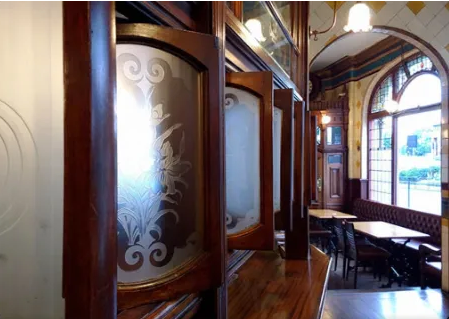
Snob Screens at The Bartons Arms, Birmingham. Opened 1901
At night, candles and oil lamps turned them into warm, smoky warrens. A pub could be a social hub, an entertainment hall, or, in some rural corners, a place where the same man who pulled your pint could build your coffin.
By 1870, Britain had over 115,000 pubs and beerhouses. One for every 130 people.
Ireland had thousands more. Barrack Street in Cork City runs less than 300 metres. It was said to have had forty-two pubs.
The pub had become as familiar as the home.
And it came with consequences: alcoholism, poverty, public disorder, men missing shifts, pay packets gone before they reached the kitchen table.
Wages were often paid on Fridays and spent at the bar before workers ever reached home. Employers complained. Churches campaigned. Reformers blamed the pub for everything from poverty to immorality. Pubs were targets in an expanding culture war between publicans, temperance advocates, industrial capital and the state.
Licensing laws restricted who could operate a public house and when. Magistrates held the power to shut down premises for disorder or moral failing. Some boroughs tightened controls; others ignored them. Local custom mattered more than written policy. A good landlord could negotiate with police, clergy and creditors well enough to keep the doors open.
Women were admitted or excluded according to unwritten rules. In some districts, a woman entering the public bar alone could be refused service; in others, she might be directed to a snug or lounge. Children were common in pubs until 1908, when the Children Act restricted their presence in bars. This change was administrative rather than cultural, but its impact was significant: pubs shifted further from mixed family spaces toward male-dominated environments. Drinking separated from domestic life. The habit of “having a pint on the way home” became a standard part of working-class routine.
By the turn of the 20th century, the pub’s architecture reflected the society that built it.
Different bars for different classes.
Different rooms for different genders.
Different service for different expectations.
A world closing in
Yet the world outside the pub was changing faster than the world inside it.
Industrialisation packed the cities of Britain to breaking point.
Between 1850 and 1900 the population of Birmingham doubled to half a million.
London went from 2.5 to 5.5 million.
By 1900, over two-thirds of the country lived in towns and cities.
In Ireland, the direction was different, and darker.
Before An Gorta Mór, the Great Hunger, the population was around 8.5 million.
By 1860, starvation, disease and mass emigration had driven it below 6 million.
Rural Ireland emptied. Country people moved to Belfast, Dublin and Cork, or left the island entirely.
Emigration continued; by 1900, Ireland’s population was down to around 4.5 million.
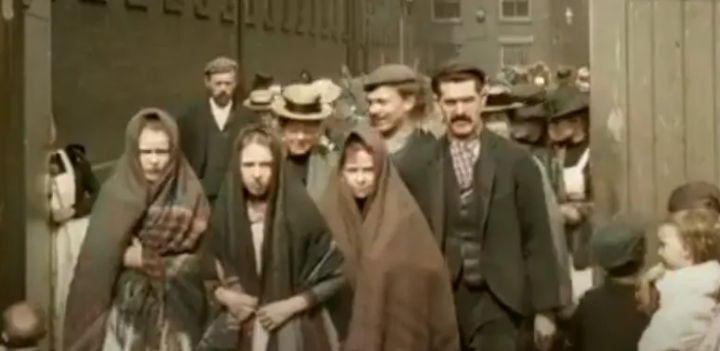
Workers leaving a factory in England in 1901
Across Britain and Ireland, mass politics was taking shape.
Trade unions, suffrage movements, Chartists, Home Rule campaigners and Irish nationalists organised in the same spaces where people drank. Meetings held in back rooms and upstairs function spaces linked drinking culture to political agitation. Authorities noticed. Surveillance increased. The pub became both a community institution and a site of suspicion.
All change
At the early 20th Century the pub was changing.
Breweries bought up thousands of premises.
Tied houses surged. Independence shrank.
Licensing laws tightened. Opening hours fell.
Pubs became mostly male spaces. The snug and the lounge did the rest.
Beer was standardised. Supply chains controlled.
What had once been local was now centralised.
The pub had adapted to technology, to regulation, to shifting morals,
but not to the state treating it as a matter of national importance.
By 1914, the pub was already strained.
Licensed and monitored.
Split by gender and expectation.
Class still visible in the grain of the bar.
An institution held up by habit more than design.
It had adapted to almost everything,
except a global crisis.
The First World War was about to change all of that.