
Drugs 4: Ideology
What We Didn’t Learn From Alcohol Prohibition
“Why don’t they pass a constitutional amendment prohibiting anybody from learning anything? If it works as well as Prohibition did, in five years Americans would be the smartest people on Earth.”
Will Rogers
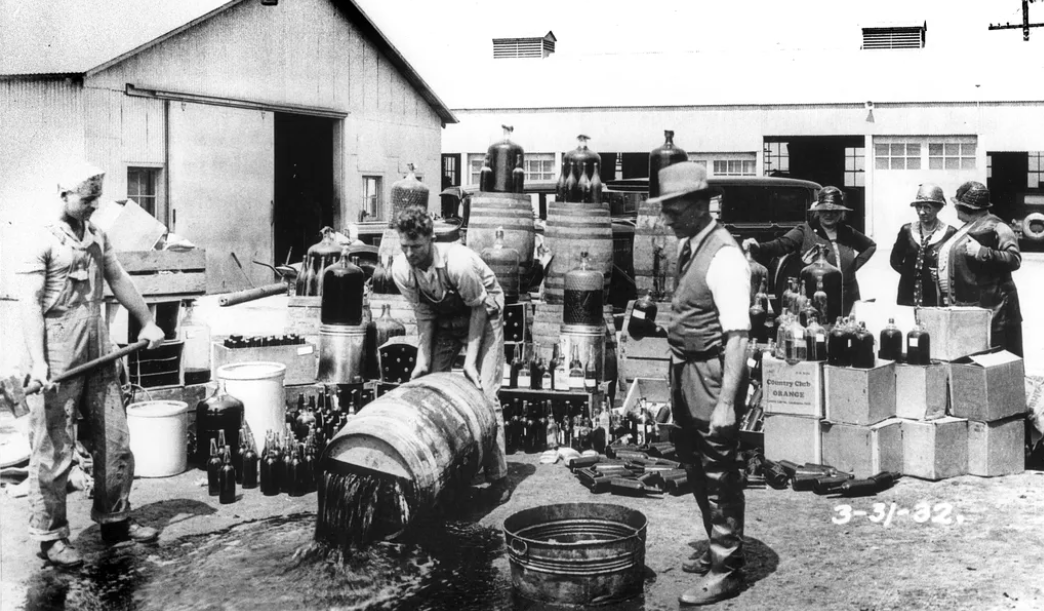
Orange County Sheriff’s Department disposing of illegal alcohol, circa 1932. Image: Orange County Archives
Occasionally, a solution is proposed with such confidence and moral certainty that, when it fails, it makes the original problem far worse.
Between 1920 and 1933, the United States government banned the production, sale, and consumption of alcohol. Prohibition had been decades in the making, driven by genuine suffering and deeply flawed solutions.
In the late nineteenth and early twentieth centuries, groups like the Women’s Christian Temperance Union and the Anti-Saloon League sought to address poverty, violence, and family breakdown they believed were caused by what they called “demon alcohol”.
They marched.
They prayed.
And when that failed, they escalated.
One of the movement’s most famous figures was Carrie Nation, nicknamed “Hatchet Granny” for her so-called “hatchetations”, who became notorious between 1900 and 1910 for smashing up saloons with a tomahawk in the name of moral reform.
Eventually, the movement won; on 17 January 1920, Prohibition became law, and the chaos began.
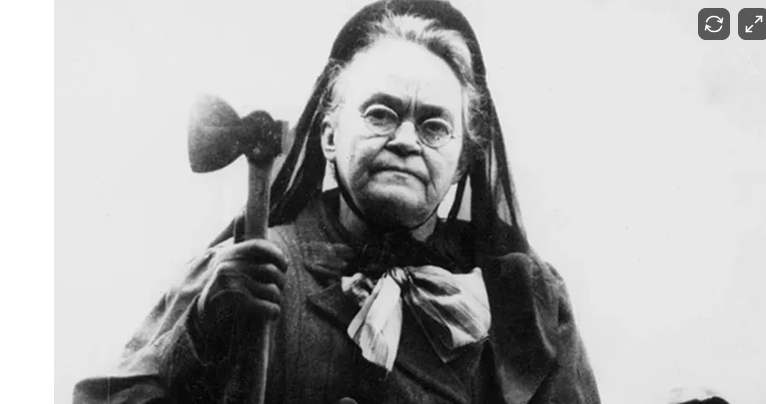
Carry A. Nation, AKA Hatchet Granny with her bible and her hatchet not long before she died in 1911.
Pesident Herbert Hoover described Prohibition as “a great social and economic experiment, noble in motive and far-reaching in purpose.” In practice, it achieved the opposite. Prohibition did not reduce harm. It put power into the hands of moral crusaders and criminal enterprises.
The targets of prohibition were not difficult to identify. Others.
Irish, German, and Italian immigrants were high on the list. Catholics, Black Americans, Mexicans, the urban poor, and anyone who failed to conform to white Protestant respectability were treated as inherently suspect.
What followed was a struggle between nativist, rural America and the communities filling its cities. Rural “Drys” enforced prohibition. Urban “Wets” ignored it"
Drinking cultures historically rooted in family and community life were reframed as evidence of moral failure. Prohibition did more than divide the country over alcohol. It handed a moral mandate to movements that had been waiting for one.
In the 1920s, the Ku Klux Klan recast itself as a force for order and “community standards”. Under the language of reform, it promised to clean up towns, shut down bootleggers, and restore Protestant respectability. Prohibition gave that message legal cover.
Between 1920 and 1925, Klan membership swelled into the millions. Many of its new supporters were also vocal advocates of Prohibition, united less by concern for alcohol than by hostility toward immigrants, Catholics, and anyone seen as not truly American.
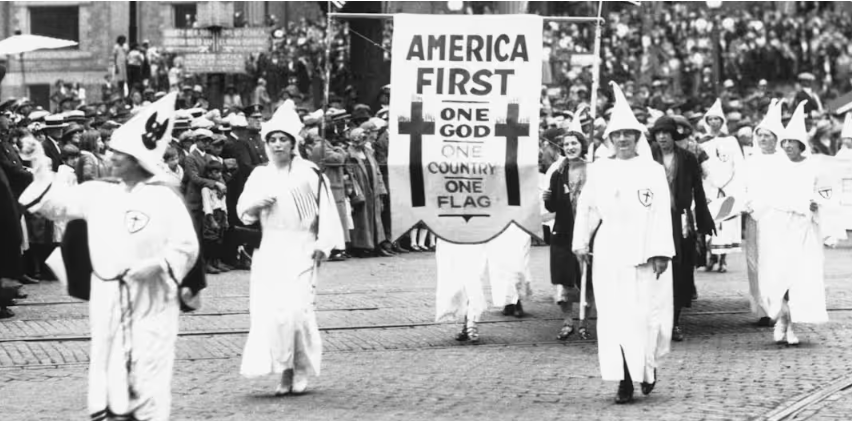
A Ku Klux Klan parade in Binghamton, New York, in the 1920s. Image: Bettmann/Bettmann Archive
While rural moral reformers claimed the law, the cities moved on.
At its peak, New York City alone had more than 30,000 illegal bars; speakeasies, gin joints, hooch houses. They were the worst-kept secret in America. Big clubs, back rooms, and underground spaces flourished.
Some were “black and tan” clubs, where Black and white patrons drank together; rare, but real.
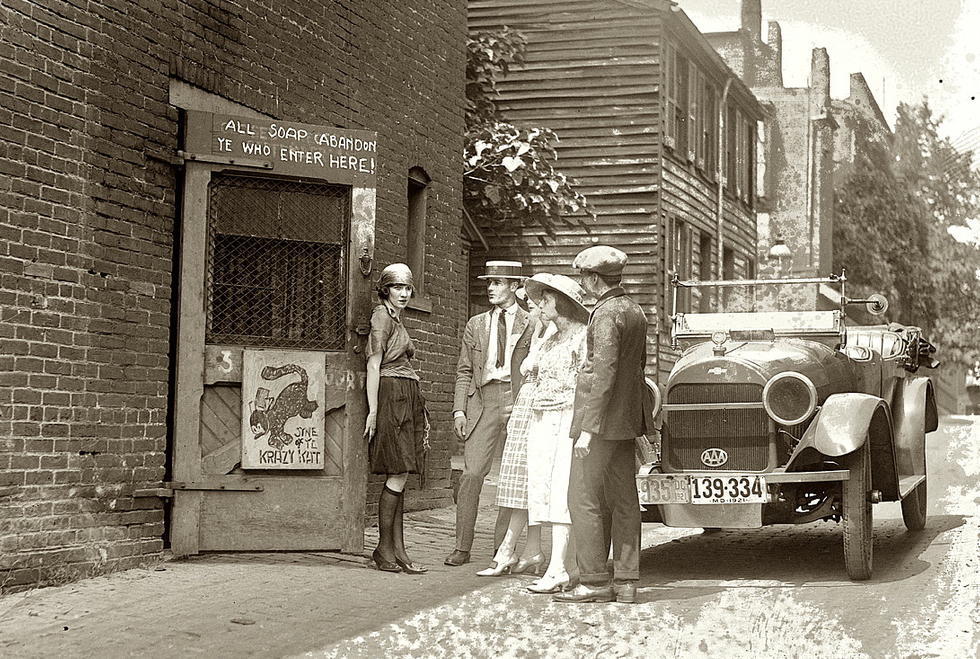
A woman eyes the photographer warily while standing at the door of a speakeasy, the “Krazy Kat,” in Washington, D.C., a hangout for the city’s bohemian crowd, circa the early 1920s. Image: US Library of Congress.
At the famous Cotton Club, the owner, Irish gangster Owney Madden, known as “The Killer”. made a fortune from bootleg alcohol and lived long enough to enjoy it.
He wasn’t alone.
Prohibition was a golden age for gangsters.
Al Capone, Lucky Luciano, Bugsy Siegel, and Frank Costello built criminal empires by supplying a product people still wanted. Capone was even treated as a folk hero, handing out money, running soup kitchens during the Great Depression, and strutting through Chicago in a white hat, like a 1920s Kardashian. By the late 1920s, Capone, was estimated to make as much as $100 million a year (around $1.3 billion in today's money)
There were some unintended yet positive side effects. Prohibition helped fuel the Roaring ’20s. Women gained new freedoms. Jazz transformed American culture. Literature and the arts flourished.
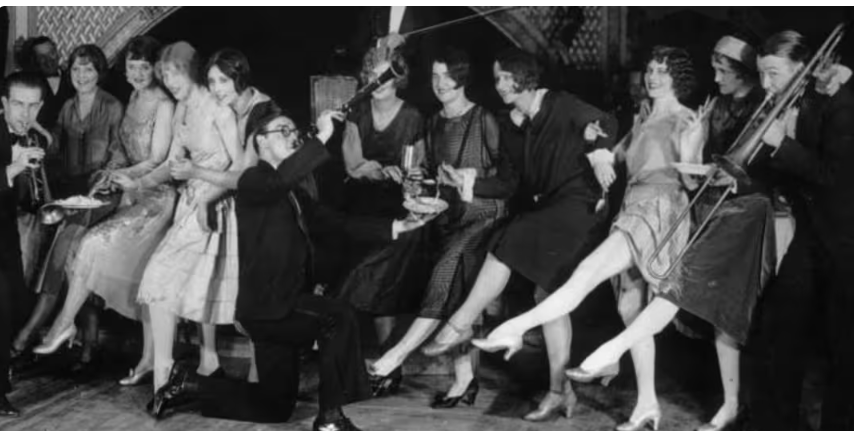
Black & White Photo of the 1920s dancing to the Charleston. Image: of Hulton Archive/Getty Images
A century later, The Great Gatsby still sells around half a million copies each year.
But as a public health policy, Prohibition failed completely.
Prohibition criminalised ordinary people. Poorly made alcohol poisoned and blinded thousands. Jobs vanished. Tax revenue collapsed, deepening the Great Depression. Police and politicians were bribed or threatened. Bootleg gangs had shootouts with police, or murdered each other in the streets in violent battles over territory.
To deter drinking, the United States government ordered industrial alcohol to be deliberately poisoned with methanol and other toxins. Bootleggers redistilled it badly. People drank it anyway.
There is no learning in the second kick from a mule.
Thousands died slow, horrific deaths by seizures, organ failure, suffocation.
The death toll was staggering. And it was entirely preventable.
The policy was repealed in 1933.
There’s an old saying: there is no learning in the second kick from a mule.
We keep making the same mistake. Same logic. Same moral panic. Same outcomes.
Alcohol prohibition didn’t fail because people loved drinking. It failed because banning a substance people already use doesn’t remove demand - it hands supply to the least accountable actors available. Safety disappears. Potency rises. Adulteration becomes inevitable. Death follows.
Prohibition doesn’t eliminate substances. It makes them more dangerous
Today’s drug prohibition repeats every one of those failures. Demand is criminalised. Supply becomes unregulated and dangerous. Enforcement falls along lines of race, class, and geography. Corruption flourishes. Violence becomes structural. And the body count grows, year after year, treated as an unfortunate but inevitable cost.
It isn’t inevitable. Prohibition doesn’t eliminate substances; it just makes them more dangerous.
Some solutions are worse than the problems they claim to fix. Prohibition is a policy built on moral certainty, sustained by ideology, and measured in lives.
This is the fourth and final entry in a short series on drugs, harm, and the stories we tell ourselves about them.