
Seven Deadly Sins, Part 6: Consumption
There’s a point in a society’s decline where the people stop eating and start being eaten.
After the 9/11 attacks, George W. Bush told Americans to go shopping: “Get down to Disney World, take your families and enjoy life.” He said it because the government was afraid the country would shut down. People were scared, the economy was wobbling, and they needed Americans to keep spending so things didn’t crash completely. It was the beginning of a new doctrine: citizens aren’t asked to sacrifice, they’re asked to spend. Instead of rationing, volunteering, or collective effort like in WWII, the message became: patriotism is buying things.
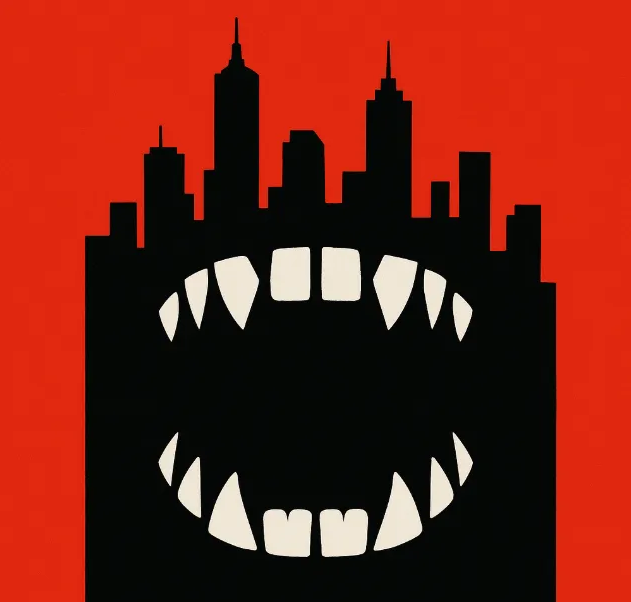
It worked too well. Consumption stopped being something people did and became something expected of them. Credit cards, mortgages, car loans, pay-later schemes, they filled the space where civic duty used to be. Instead of asking people to participate in democracy, the system asked them to keep the wheels turning. Buy a house you can’t afford, drive a car you don’t need, fill your life with things that don’t make it better. Your value wasn’t in who you were, but in how much you could feed the machine. And once you teach a whole population to live like that, the next step is inevitable: sooner or later, the machine starts feeding on them.
There’s a point in a society’s decline where the people stop eating and start being eaten. Eventually everyone gets a turn. Everybody gets consumed. We don’t call it a sin, of course. We call it “keeping up with the Joneses.”
Eventually, everyone gets a turn. Everybody gets consumed.
Consumption used to mean ownership: the things you bought, the things you ate. Now it’s more like a slow erosion. You get chipped away by notifications. You get worn down by news cycles. You get shaped by expectations, work, social norms, the idea that you should always be improving, always performing, always grinding.
Addiction fits into this sin so neatly because the whole thing is built for it. We’re wired for the dopamine trap. It’s biology. Nature wants one thing from you: the next healthy generation. To get that, you need to eat, move, and have sex , and nature came up with a brutally effective way to keep you doing all three. It built a reward system in your head: dopamine. Do something useful, you feel good; you like the feeling, so you do it again.
The dopamine-trap economy is one of the few truly bipartisan systems on earth. Every industry, tech, entertainment, food, sport, gambling, wellness, drugs, runs the same playbook: hook, hold, harvest. Want another video? Another sale? Another bet? Another day of overwork? Another hit? The system doesn’t care what you want. It only cares that you stay for the next bite.
And if you don’t? If you get tired? If you burn out?
Well, that’s your fault for not being “resilient” enough.
Late-stage capitalism has an incredible skill: it devours you and then asks you for more. The gig worker, the warehouse picker, the casualised teacher, the nurse rotating shifts through a pandemic that refuses to end, nobody escapes.
Climate collapse is another form of consumption - the future eaten by the present. Fossil fuel companies gorge on the last scraps of a habitable planet. Politicians stuff themselves with donations while pretending they can’t hear the crackle of burning forests. An it is pretense. Besides the cookers, even the most brutal of climate-deniers knows it’s real but it’s in their interest to say otherwise.
Recycle all you like. Buy sustainable. Choose “ethical” products. Drops in the ocean. The whole system is built on burning through lives and landscapes like kindling. And somehow we still end up blaming ourselves for not doing enough, as if a reusable coffee cup is going to frighten Exxon into repentance.
If anything changes, it won’t be because we recycled harder. It’ll be because the people profiting from collapse finally get forced to stop. This isn’t an individual problem it’s a political one. And the only thing that scares the system is pressure, not paper straws.
Consumption worms its way into your identity, into your mind. Everything becomes something to devour or something devouring you. Food stops being food and becomes discipline, shame, trend. Poverty becomes the fault of the poor. Refugees become people “consuming local’s opportunities.” Even suffering gets repackaged as a resource someone else can mine.
The US prison-industrial complex is the purest example of a system feeding on its own people. A country with barely 4% of the world’s population cages around a quarter of ALL the world’s prisoners.
Private prison giants like CoreCivic and GEO Group rake in billions while lobbying for harsher laws to keep the cells full. Incarcerated people generate billions in goods and services and get paid pocket change; sometimes 23 cents an hour for the privilege of being exploited. And even the so-called “public” prisons are just storefronts for private profit. Aramark sells them food, Securus bleeds families dry for phone calls, Corizon cuts healthcare to the bone, the bail bond industry cleans up, and Wall Street investors skim off the top.
This isn’t a justice system. It’s an industry. A factory of bodies being fed into the machine like meat.
We used to consume media. Now media consumes us. True crime feasts on tragedy. News outlets feast on fear. Social media gnaws at your insecurities like a pack of hyenas. You’re not their customer; you’re the product they toss to advertisers.
And the worst part is that we know. We all know. We feel the system’s hunger because there’s something hollow in us that the machine is designed to exploit.
But what choice do you have? Step off the carousel and you stop existing. Disconnect and you disappear.
So you keep feeding it.
And it keeps feeding on you.
Consumption works because the system needs you malnourished, emotionally, financially, spiritually, just enough to keep crawling back for one more hit of comfort. One more parcel. One more episode. One more shift. One more sacrifice.
But even with all this, there’s still a part of you the system can’t break. The part that knows when something feels wrong. The part that wants time, quiet, something that isn’t being shoved at you 24/7. It’s not spiritual or dramatic. It’s just the basic human instinct to pull back when you’re being used.
And that tiny instinct is enough. The system hates it, because it can’t monetise it or bully it. It wants you on autopilot, tired enough to agree to anything. The moment you stop and think, even for a second, you slow the whole thing down.
You don’t need to overthrow anything. You just need to stop letting yourself be chewed up. You can reject the idea that exhaustion makes you a good person. You can decide you’re not a machine. You can keep a small part of your life for yourself and refuse to hand it over.
You don’t need a revolution. You just need to stop letting yourself be chewed up.
That’s what resistance looks like now.
Consumption isn’t something you escape alone, but you can push back.
And even a tiny push counts.
The world will keep trying to take its turn.
But you get a turn too.