
THE STORY OF COCAINE, PART FOUR: THE WHITE GOLD RUSH
By the 1970s, Prohibition Turned Cocaine Into Empires
By the 1970s, cocaine had created empires. In Colombia, powerful cartels, most notably the Medellín Cartel, centralised cocaine trafficking on an industrial scale. Figures like Pablo Escobar and Carlos Lehder used Caribbean routes and Miami as a gateway to flood the United States with cocaine, generating unimaginable profits and equally unimaginable violence. The trade became more organised, more ruthless, and more efficient, reshaping the global drug economy in the process. In the United States, the “Cocaine Godmother” Griselda Blanco built a brutal trafficking network linking New York and Miami, closely tied to Medellín and infamous for using extreme violence as a management strategy. Alongside her, American kingpins like Frank Lucas made it clear that this was not a foreign invasion but a domestic enterprise, amassing vast wealth through complex supply chains while the state framed the crisis as something imported. The cocaine boom was global, corporate, and deeply embedded on both sides of the border, exactly the kind of market prohibition was designed to create.
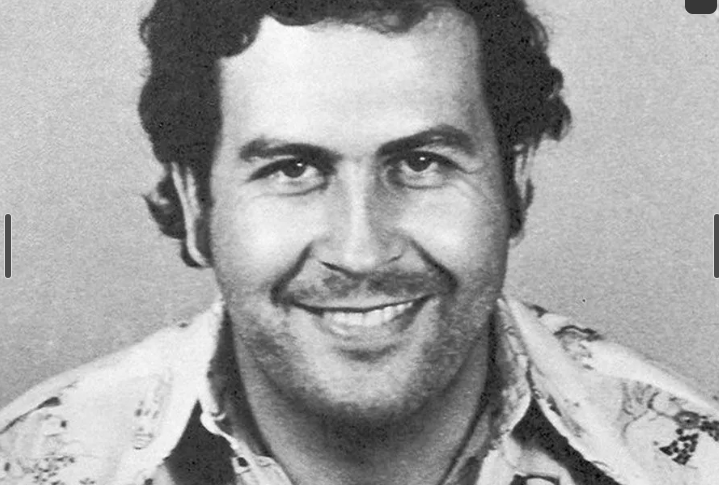
Pablo Escobar
On the other side, prohibition militarised policing. Governments poured money into law enforcement, expanding police powers and reframing drug use as a battlefield problem rather than a social one. The creation of the Drug Enforcement Administration in 1973 locked this mindset into place, embedding a permanent federal agency whose sole purpose was to pursue drugs and the people connected to them. The language of “war” quickly became literal. Military equipment, combat-style training, and national security resources were redirected into anti-smuggling operations at home and abroad. In South America and elsewhere, the United States backed foreign governments and security forces in campaigns against cartels, often deepening corruption, repression, and regional instability rather than reducing harm. Domestically, these tactics filtered into everyday policing, normalising raids, surveillance, and aggressive enforcement that fell hardest on minority communities, leaving behind a legacy of violence, mistrust, and trauma that long outlived the slogans that justified it.
The poor were punished while the rich partied
By the late 1970s, the cocaine industry had become the purest expression of capitalism, and Miami was its heart. South Florida turned into a distribution hub, with speedboats skimming the coast and airdrops disappearing into the Everglades. Cash arrived faster than it could be counted; money was weighed instead. The era of the Cocaine Cowboys wasn’t stylised excess, it was open, public violence. Assassinations in shopping centres. Bodies dumped on highways. A city briefly drenched in blood.
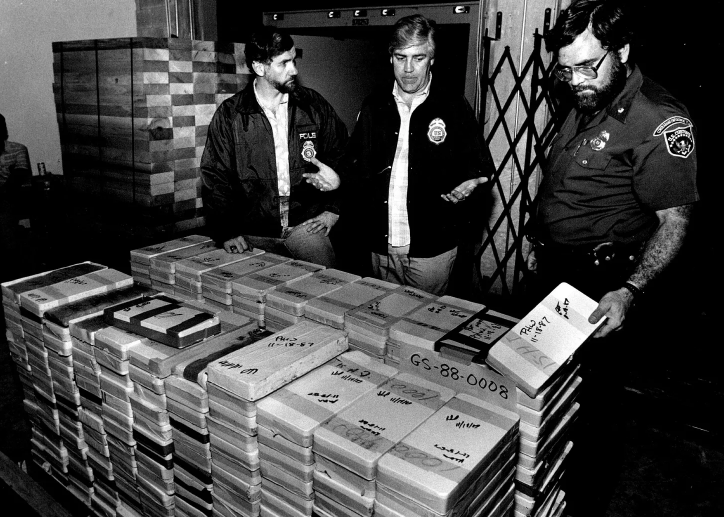
Federal agents with some of the 6,292 pounds of cocaine smuggled inside a wooden picnic table in 1987, Chris Usher The Miami Herald
At its peak in the late 1970s and early 1980s, the Medellín Cartel was making an estimated US$60–70 million a day, around US$20–22 billion a year, closer to US$55–60 billion in today’s money. Corruption was considered an operating expence. Huge sums were funnelled into buying off police, judges, and politicians, factored into the cartel’s profit-and-loss calculations. Compliance, however, was never really a choice. Those who could be bribed were. Those who couldn’t were killed. The choice was brutally simple: “plata o plomo", silver or lead.
During the same decade, as the United States escalated its War on Drugs, elements of the American-backed Contra forces in Nicaragua were implicated in cocaine trafficking, with profits used to fund a proxy war Congress had explicitly restricted. Drugs poured into marginalised communities in the US while politicians sharpened sentencing laws and preached personal responsibility. Cocaine didn’t undermine the state. In key moments, it served it.
The hypocrisy is impossible to ignore. Street-level dealers were locked up for decades. Entire communities were criminalised. Meanwhile, the money moved freely upward. Banks accepted deposits without asking too many questions. Real estate absorbed cash at scale. Art markets, shell companies, and offshore accounts laundered cocaine profits until they were indistinguishable from any other form of wealth.
The poor were punished while the rich partied.
Pop culture helped sell the fantasy. Films like Scarface framed cocaine as excess, ego, and downfall, but always seductive. Nightclubs, fashion, music, white suits, mirror tables. The aesthetic was sharp, fast, glamorous. The body count stayed off-screen.
But prohibition only ever increases harm.
The damage comes from turning a high-demand commodity into an illegal one without removing demand. When courts are replaced by guns, disputes are settled with bullets. Every crackdown raises prices. Every seizure tightens supply. Every politician declaring victory makes the market more lucrative.
Cocaine became white gold.
By the early 1990s, the mythology began to crack. In 1991, Pablo Escobar surrendered to Colombian authorities under a deal that protected him from extradition to the United States. His “imprisonment” took place in La Catedral, a luxury compound he designed and controlled, complete with entertainment facilities and unrestricted communications. From inside, he continued to run his operation. The arrangement collapsed in 1992 after Escobar kidnapped and murdered two cartel associates on the premises. When authorities attempted to transfer him to a conventional prison, he escaped.
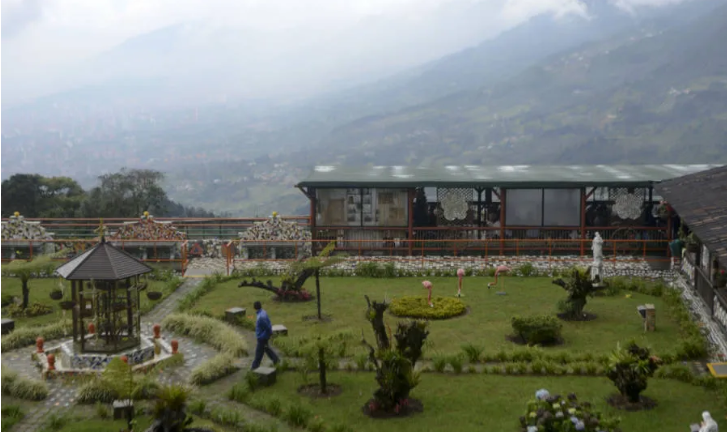
The prison known as La Catedral (“The Cathedral”). RAUL ARBOLEDA/AFP/Getty Images
A year-long manhunt followed, led by Colombian forces with substantial US intelligence support and assisted indirectly by rival traffickers. On December 2, 1993, Escobar was located in Medellín. A rooftop chase and gunfight ensued, and he was killed. Whether he died from police fire or by his own hand remains disputed. His death ended the Medellín Cartel’s dominance, but not the trade itself, which simply reorganised under new management.
The War on Drugs didn’t fail. It did exactly what it was designed to do
Overdose deaths rose. Cartels fractured. Violence escalated. Yet the system endured, because it was never really about health or safety. It was about control, punishment, and profit. The War on Drugs didn’t fail. It did exactly what it was designed to do: criminalise the vulnerable, enrich the powerful, and preserve moral authority.
The real legacy of the White Gold Rush is the normalisation of blood money in respectable places, and the enduring lie that prohibition protects people, when history shows it only protects markets.
Cocaine didn’t corrupt the system.
It built it.