
THE STORY OF COCAINE, PART THREE: WHITE LIES
How One Man’s Racism Created the War on Drugs
In 1920, in a federal office in Washington, D.C., a young bureaucrat was learning how fear could be shaped into policy. Harry Anslinger worked for the U.S. Treasury Department in Prohibition enforcement. He was not a doctor. He was not a scientist. He had never treated a patient or studied a drug in a laboratory. What he was, was a racist who understood how to turn fear into policy. By the time he rose to national prominence,, cocaine would no longer be a substance to be studied. It would be a substance to be hunted.
What he understood instead was how to turn fear into policy.
The shift from medicine to illicit drug did not arrive all at once. It crept in through committees and quietly passed laws. In 1914, the United States introduced the Harrison Act, framing drug use not as a health matter but as a problem of regulation, taxation, and crime. On paper it targeted distribution. In practice it criminalised users and cast suspicion on doctors.
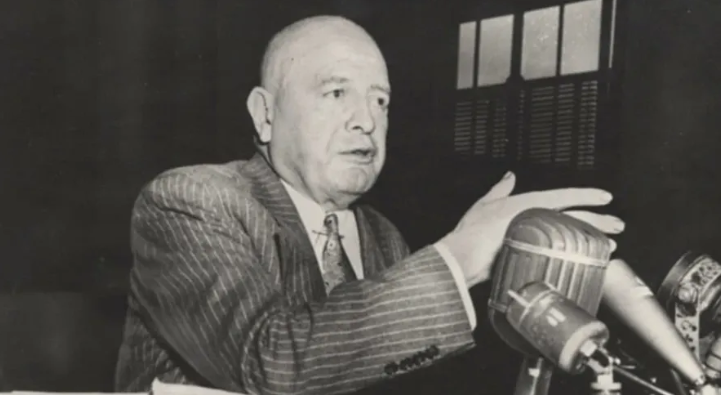
Harry Anslinger is widely considered the father of the modern War on Drugs
Doctors who had once prescribed cocaine now hesitated or stopped entirely. Some were arrested. Under the Harrison Act, doctors could legally prescribe drugs only for what the state decided was “legitimate medical use.” Many continued maintaining dependent patients on cocaine or opiates to prevent withdrawal. Courts later ruled this was not legitimate treatment but “aiding addiction.” Doctors were charged with illegally supplying narcotics, maintaining addicts, and failing to force abstinence.
Addict replaced patient. Vice replaced illness. Enforcement replaced care.
The language of drug use changed. Addict replaced patient. Vice replaced illness. Enforcement replaced care. Patients who had once been treated became offenders by default.
Anslinger watched how fear could be amplified, how a chemical could be turned into a public enemy, how statistics could be shaped into headlines and headlines into law. Prohibition had taught him that morality, when armed and funded, was more powerful than evidence. By the early 1920s, the machinery was in place. Files were opened. Registers were built. Surveillance became policy. What had begun as scattered panic was being engineered into something permanent.
The drug had not changed. The world around it had.
In 1930, Anslinger was appointed head of the newly formed Federal Bureau of Narcotics. The bureau was small, underfunded, and desperate for purpose. Prohibition was collapsing, and the vast enforcement apparatus built to police alcohol needed a new enemy to justify its survival. Anslinger understood that better than anyone. And, as he had learned from the alcohol war, enemies were easier to manufacture than to find.
During Prohibition, sensational headlines had held the country captive; Anslinger simply redirected that machinery. Cocaine became the new threat. He fed the press a steady diet of fear, and newspapers, addicted to the revenue of moral outrage, obliged him. Cocaine was recast as a predator, a lurking menace, a moral contagion.
Cocaine was more useful to Anslinger as a story than as a target.
In reality, cocaine was more useful to Anslinger as a story than as a target. Heroin and marijuana made better arrests. Cocaine made better headlines.
Race did the rest. The old Prohibition-era enemies, the Irish, Germans, and Italians, were replaced with African Americans, Mexicans, and Chinese. Drugs were framed as something seeping out of Black and immigrant neighbourhoods toward respectable white suburbs. Cocaine became not just a substance but a symbol of moral decay. It did not merely harm individuals; it threatened the nation itself.
Race did the rest.
Anslinger’s racism shaped more than policy. His war was never just about drugs. He launched an equally ferocious crusade against Black Americans and Mexican immigrants, and drugs were the ammunition. He claimed marijuana and cocaine turned Black men into criminals and white women into their victims, and used these fantasies to push for national prohibition. The racism wasn’t incidental. It was the fuel.
Nowhere was Anslinger’s racism clearer than in his persecution of Billie Holiday. Holiday was Black, outspoken, and refused to stop performing “Strange Fruit,” a song that called out the lynching Anslinger preferred to ignore. He swore to break her. His agents hounded her for years, arrested her for addiction instead of treating it as illness, and in 1959 handcuffed her to a hospital bed as she was dying. Her death was framed as a warning. In truth, it was an indictment of the machine he had built.
The Federal Bureau of Narcotics pushed for tighter controls, harsher penalties, and broader definitions of what constituted a drug offence. Medical voices who questioned the clampdown were ignored or painted as naïve. Addiction was recast as deviance, criminality, weakness of character. Lawmakers spoke of drugs in the same breath as treason.
The United States began exporting its moral panic. International treaties originally designed to regulate the opium trade were expanded to include cocaine. At conferences in Geneva and The Hague, American delegates insisted that global drug control should mirror American enforcement: strict, punitive, and intolerant of nuance. Where other nations argued for medical oversight, the U.S. argued for police power. America won.
By the late 1930s, cocaine had been pushed out of every legitimate channel. Doctors could hardly prescribe it. Pharmacies could not stock it. Researchers could not access it. The drug that had once been a medical breakthrough was now treated as an existential threat.
Only one route remained: the underground.
Criminalisation did not eliminate cocaine. It eliminated the structures that had once managed it safely. Supply moved to smugglers. Quality plummeted. Violence increased. The very harms the laws claimed to prevent were amplified by the laws themselves.
Each headline funded another year of enforcement.
But for Anslinger, this was proof, not failure. Each arrest justified the next. Each seizure validated the machinery. Each headline funded another year of enforcement.
By the time the world stepped into the 1940s, the drug war had become self-sustaining. Cocaine was no longer the problem. The system was.
Al Capone once shrugged off alcohol prohibition with two lines: “All I do is supply a public demand. I do it in the best and least harmful way I can. If I break the law, my customers are as guilty as I am.” He understood something lawmakers never dared admit: where there is demand, there will be supply.
The same logic applied to cocaine. When the law pushed it out of pharmacies, it didn’t vanish. It migrated into nightclubs, brothels, jazz halls, gambling rooms, hotel suites, and the darker corners of cities.
Organised crime still saw heroin as more profitable than cocaine, and alcohol rackets continued to pay the bills. Charles “Lucky” Luciano, Meyer Lansky, Bugsy Siegel - none built cocaine empires, but their networks gave cocaine exactly what it needed: protection, privacy, and customers. Owney Madden, the Irish gangster who ran the Cotton Club in Harlem, New York, made sure his entertainers and wealthy patrons had access to whatever they wanted, including cocaine.
Two distinct stories had formed. In the popular imagination, cocaine lived in the ghetto. In reality it had become a glamour drug, a whisper rather than a street problem. A stimulant for musicians who needed one more set, actresses who needed one more hour, and industrialists who needed one more meeting. It floated through jazz clubs in Chicago, nightclubs in New York, studios in Hollywood, and casinos in Havana.
Enforcement barely touched this world. Cocaine was the fear Anslinger sold; heroin and marijuana were the fears he policed. The Bureau relied on cocaine headlines to fund heroin and marijuana arrests. So the drug lived quietly, cautiously, but persistently, gathering networks, surviving lean years, waiting.
“The state had not eliminated cocaine. It had handed it to the underworld.”
The state had not eliminated cocaine.
It had handed it to the underworld, and the underworld never misses an opportunity.